Defining the Core Elements of a Strong Digital Presence
A robust digital presence in April 2026 is far more than just having a website or a social media profile; it’s a cohesive ecosystem of online touchpoints that collectively shape how your brand is perceived. This ecosystem includes everything from your website and social media channels to online listings, reviews, and search engine visibility. The goal is to ensure a consistent, accurate, and engaging representation of your brand across all these platforms.
Consider the data: 91% of customers emphasize the importance of accurate brand information online. Yet, a significant 94% of customers look for brand information on websites beyond just major search engines or social media platforms. This highlights the need for an omnichannel approach, where your brand is discoverable and consistent wherever potential customers might be searching. Maintaining this consistency, from your brand voice to visual identity, is paramount. An infographic can help visualize this intricate web of interactions:
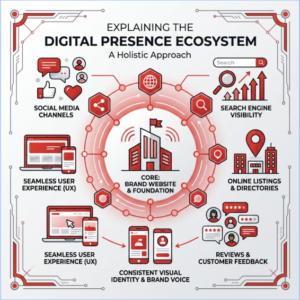
Furthermore, user experience (UX) is a critical component. With 75% of consumers judging a business’s credibility based on its website design, and the average webpage visit lasting only 54 seconds, first impressions are everything. We must ensure that every digital interaction is seamless, intuitive, and leaves a positive impression. This extends to the accuracy and consistency of your Name, Address, and Phone (NAP) information across all online directories, which is crucial for both local search visibility and building trust. To truly grow digital presence in this dynamic environment, businesses must adopt a holistic strategy that integrates all these elements.
How a Website Serves as Your Digital Presence Foundation
Your website is the digital headquarters of your business. It’s the central hub where all other digital marketing efforts should ultimately lead. In 2026, a website is often the very first interaction a potential customer has with your brand, and snap judgments are made quickly—often within three seconds. If your site is slow, difficult to navigate, or visually unappealing, you risk losing that visitor immediately.
A strong website must be mobile-first, ensuring a flawless experience on any device, given the prevalence of mobile browsing. It should feature intuitive navigation, allowing users to find information effortlessly, and clear calls-to-action (CTAs) that guide them towards desired outcomes, whether it’s making a purchase, signing up for a newsletter, or contacting your team. Beyond aesthetics, a modern website should also allow for easy self-management, enabling you to keep content fresh and relevant without constant reliance on external developers. In fact, 56% of consumers won’t even consider a business that doesn’t have a website, underscoring its foundational importance. It’s the ultimate tool for expanding your online footprint and establishing credibility.
The Role of SEO in Enhancing Online Visibility
Search Engine Optimization (SEO) is the engine that drives visibility to your digital presence. It’s the process of optimizing your website and online content to rank higher in search engine results pages (SERPs), making it easier for potential customers to find you when they’re actively searching for products or services. This involves meticulous keyword research to understand what terms your audience is using, followed by strategic integration of these keywords into your content.
But SEO in 2026 goes beyond just keywords. Technical optimization, such as ensuring fast page load times, mobile responsiveness, and a secure website (HTTPS), is crucial for search engine algorithms. Local SEO is particularly vital for businesses serving a specific geographic area, helping them appear in “near me” searches and map results. Building authority through high-quality backlinks from reputable sources and maintaining a strong backlink profile signals to search engines that your site is a trusted resource. The payoff is significant: brands with broader publisher network coverage can see up to 186% better overall web performance from Google, indicating the power of a comprehensive SEO strategy in attracting high-intent traffic.
Strategies to Expand and Amplify Your Reach
Once the foundational elements of your digital presence are in place, the next step is to actively expand and amplify your reach. This involves strategically utilizing various digital channels to connect with your target audience, build brand awareness, and drive engagement. A multi-channel marketing strategy ensures that your message resonates across different platforms, reaching customers wherever they spend their time online.
Content marketing, email newsletters, and paid advertising are powerful tools in this amplification process. By creating valuable content that addresses your audience’s needs and interests, you not only attract organic traffic but also establish your brand as an industry authority. Email marketing allows for direct, personalized communication, nurturing leads and building customer loyalty. Paid advertising, such as Pay-Per-Click (PPC) campaigns, provides immediate visibility and targeted reach, complementing your organic efforts. The synergy between these strategies can significantly boost your online performance. For instance, brands leveraging broader publisher networks have seen up to a 186% improvement in overall web performance from Google, demonstrating the power of a diversified approach. Businesses that consistently blog, for example, can see a 55% increase in website visitors, leading to substantial growth.
Leveraging Social Media for Brand Engagement
Social media is no longer just a platform for personal connections; it’s a vital channel for businesses to humanize their brands and foster genuine engagement. In 2026, an active social media presence is a strong indicator of trustworthiness, with 59% of customers more likely to trust a brand that actively engages on these platforms. It allows for direct interaction with your audience, providing opportunities to respond to queries, gather feedback, and build a loyal community.
The key to effective social media presence lies in strategic platform selection. Instead of trying to be everywhere, focus on the platforms where your target audience is most active, whether it’s LinkedIn for B2B networking, Instagram and TikTok for visual content and younger demographics, or Facebook for broader community building. Short-form video content, in particular, has exploded in popularity, generating 1200% more shares than text and image posts combined. This emphasizes the importance of incorporating dynamic, engaging video into your social media strategy. Moreover, with platforms like TikTok and Instagram increasingly functioning as search engines for younger audiences, your social media content can directly contribute to your brand’s discoverability.
Content Creation as a Tool for Digital Presence Growth
Content creation is arguably the most potent tool for defining and strengthening your web presence. It’s how you communicate your brand’s values, expertise, and offerings to the world. High-quality, valuable content—whether it’s blog posts, articles, videos, infographics, or value-added email newsletters—serves multiple purposes: it attracts new visitors, educates your audience, builds trust, and establishes your brand as a thought leader.
Consistent blogging, for example, can lead to remarkable results. Businesses that blog consistently (e.g., four times a week) not only generate 3.5 times more traffic but also achieve 4.5 times more leads. This demonstrates the compounding effect of a well-executed content strategy. Beyond your own platforms, guest posting on reputable industry websites can expand your reach and build valuable backlinks, further enhancing your topical authority. The focus should always be on creating original, insightful content that genuinely addresses your audience’s questions and pain points, rather than simply churning out keyword-stuffed articles. Evergreen content, which remains relevant over time, is particularly valuable for long-term growth and sustained traffic.
Protecting and Maintaining Your Online Reputation
In the digital-first landscape of April 2026, your online reputation is a critical asset that demands constant vigilance and proactive management. With 89% of global consumers checking online reviews before making a purchase, and 71% stating that reviews influence their decision to trust a brand, the perception your brand cultivates online directly impacts your bottom line. Negative or inaccurate information can be highly detrimental; 64% of customers are likely to switch brands if they encounter such content.
This makes reputation management an indispensable part of your digital presence strategy. It involves actively monitoring online mentions, responding to feedback (both positive and negative), and strategically building a positive narrative around your brand. Sentiment analysis tools can help track public perception, allowing for timely intervention when negative trends emerge. We understand the urgency: 69% of customers expect a response to reviews or comments within a week. When faced with truly harmful or misleading content, knowing how to Delete negative digital reviews and pursue removing harmful online content becomes essential for safeguarding your brand’s integrity.
Proactive monitoring and a clear strategy for responding to feedback are crucial. Every interaction, whether a glowing review or a scathing critique, is an opportunity to demonstrate your brand’s commitment to customer satisfaction and transparency.
Managing Reviews and Building Credibility
Online reviews are powerful trust signals, influencing not only purchasing decisions but also your search engine rankings. The quantity, recency, and diversity of reviews across various platforms, as well as the authority of the reviewers, all contribute to your brand’s online credibility. Actively encouraging satisfied customers to leave reviews is a best practice, as is maintaining a presence on key review sites relevant to your industry.
Transparency and responsiveness are key when managing reviews. Thank customers for positive feedback and, crucially, address negative reviews promptly and professionally. Acknowledge the customer’s concern, apologize if appropriate, and offer a solution or move the conversation offline to resolve the issue privately. Once resolved, it’s often beneficial to post a brief public update. This demonstrates to potential customers that your brand is attentive, accountable, and committed to customer satisfaction, even when facing criticism. Treating reputation as an ongoing asset, rather than a one-time fix, ensures long-term credibility and resilience.
Emerging Trends and Future-Proofing Your Strategy
The digital landscape is in constant flux, and staying ahead of emerging trends is vital for future-proofing your digital presence. In April 2026, one of the most significant shifts is the rise of AI-driven search and Generative Engine Optimization (GEO). Traditional SEO is evolving as AI search tools, like those integrated into major search engines, increasingly provide summarized answers and direct recommendations based on user queries.
This means that content needs to be structured and presented in a way that AI can easily understand, process, and cite. Brands that create clear, authoritative, and machine-readable content using structured data (Schema.org) will be rewarded with greater visibility in these new search paradigms. Voice search is another growing trend, requiring content optimized for conversational queries.
Beyond search, data privacy regulations continue to evolve, necessitating transparent and ethical data handling practices. Personalization, driven by AI, allows for highly tailored user experiences, making content and offers more relevant to individual customers. Automation tools are streamlining various aspects of digital presence management, from social media scheduling to customer service. Businesses must embrace these changes, adapting their content, technical infrastructure, and engagement strategies to align with the capabilities and demands of AI-powered digital interactions. Anticipating these shifts and proactively integrating them into your strategy will ensure your brand remains relevant and competitive.
Frequently Asked Questions about Digital Presence
Why is a digital presence essential for businesses in 2026?
In 2026, a strong digital presence is not merely beneficial; it is absolutely essential for business survival and growth. As we’ve seen, 97% of consumers now go online to research businesses before making any purchasing decisions. Without a visible and credible online footprint, your business effectively becomes invisible to the vast majority of your potential customer base. This “invisibility” carries significant costs, as competitors with robust digital presences will inevitably capture market share.
A well-managed digital presence provides a crucial competitive advantage, building brand authority and fostering trust. It allows for a compounding effect, where consistent effort over time leads to exponentially greater results in terms of reach, engagement, and conversions. Consumer expectations in 2026 are higher than ever; they expect brands to be accessible, responsive, and transparent online. Meeting these expectations through a strong digital presence is fundamental to establishing credibility, nurturing customer relationships, and driving sustained business success.
What are the most common mistakes to avoid when building an online footprint?
Building a strong digital presence is a strategic endeavor, and several common pitfalls can undermine even the best intentions. One of the most significant mistakes is inconsistent branding. Fragmented messaging, disparate visual identities, or varying brand voices across different platforms can confuse your audience and erode trust. Similarly, ignoring mobile users by failing to optimize your website and content for mobile devices is a critical error, given the dominance of mobile browsing.
Another serious mistake is attempting to buy fake reviews or engaging in other unethical practices. While tempting for a quick boost, these tactics are often detectable and can severely damage your credibility. Silence during a crisis or neglecting to respond to negative feedback allows misinformation to fester and can alienate customers. Many businesses also make the error of neglecting SEO, assuming that simply having a website is enough. Without proper optimization, your site will struggle to rank, making it difficult for customers to find you. Finally, a fragmented messaging strategy, where different departments or teams communicate independently without a unified approach, can lead to an incoherent and ineffective digital presence. Businesses must avoid these missteps to ensure their online efforts are productive and sustainable.
How can businesses measure and maintain a robust digital presence over time?
Measuring and maintaining a robust digital presence requires ongoing effort and a commitment to data-driven decision-making. We can’t simply “set it and forget it”; the digital landscape is too dynamic. Key performance indicators (KPIs) include website traffic, conversion rates, social media engagement metrics (likes, shares, comments), and the overall “Presence Score” which can simplify metrics like share of voice, reach, and mentions into one digestible score.
Sentiment tracking, often through social listening tools, is crucial for understanding public perception and identifying potential issues early. Regular quarterly audits of your website, SEO performance, social media channels, and online listings are essential to identify areas for improvement and ensure consistency. Performance analytics tools (like Google Analytics) provide invaluable insights into user behavior, allowing you to refine your strategies. Consistent oversight across all touchpoints ensures that your brand reflection remains accurate and positive. Regularly updating your digital strategy based on performance data, emerging trends, and evolving customer preferences is the only way to ensure your digital presence remains dynamic, effective, and resilient over time.
Conclusion
In April 2026, a brand’s digital presence is undeniably its most valuable asset. It’s the sum total of every online interaction, impression, and piece of information that shapes public perception. Building a strong digital presence is a strategic investment, not an optional expense, and it’s fundamental for long-term growth and sustained success in our digital-first world.
From the foundational strength of an optimized website and the visibility driven by SEO, to the human connection fostered through social media and the authority built via content creation, every element plays a crucial role. Moreover, proactive management of your online reputation, including diligently handling reviews and addressing harmful content, is paramount to building and maintaining trust. As we look ahead, embracing emerging trends like AI-driven search and adapting to evolving consumer behaviors will be key to future-proofing your strategy. By taking a comprehensive, proactive approach, businesses can not only establish a commanding digital footprint but also ensure sustainable visibility and unwavering credibility in the ever-evolving online ecosystem.