
The digital landscape is constantly evolving. In April 2026, we are well into the Web3 era. This new internet is reshaping how we interact and create value. It offers modern creators unprecedented opportunities for ownership and direct engagement. However, it also introduces a complex, low-trust environment. Here, a strong brand identity is not just an advantage; it is essential for survival and growth.
For many projects, initial hype fades quickly. Long-term success depends on building deep trust and a clear, authentic presence.
This comprehensive guide will explore the critical intersection of Brand Identity and Web3. We will uncover how Web3 branding differs from traditional approaches. We will also examine its core principles, from decentralization to community ownership. We will provide a roadmap to evolve your brand from an early vision into a trusted presence. Finally, we will share actionable strategies for engaging communities, avoiding common pitfalls, and measuring your impact in this dynamic space.
The advent of Web3 marks a fundamental shift in how brands are conceived, built, and experienced. Unlike the centralized, corporate-controlled structures of Web2, Web3 champions decentralization, community-led growth, and user-centric models. This new paradigm empowers individuals with data sovereignty, allowing them to own their digital assets and identities truly. The market valuation of Web3 has surged beyond $2.7 trillion, reflecting a robust and expanding ecosystem where participatory culture and shared ownership are becoming the new norm for digital “cultural infrastructure.” For modern creators and projects, understanding this shift is paramount. It means moving beyond traditional marketing to building genuine connections and shared value. Crafting a compelling brand in this space requires a deep understanding of these underlying principles, something that dedicated Vernacular brand and content architects are increasingly specializing in.
Defining Brand Identity and Web3 for Modern Creators
In Web3, brand identity transcends static logos and marketing campaigns; it becomes a “living system.” Projects operate less as authoritative entities and more as facilitators, guiding meaning while allowing it to evolve organically through community interactions. This means a brand’s identity is portable, existing across various digital environments, and verifiable on-chain. For digital-native audiences, this offers unprecedented transparency and trust. The core of Web3 branding lies in its ability to foster interoperability, enabling identities and assets to move seamlessly across platforms and applications. This dynamic nature demands a brand identity that is not only visually compelling but also deeply integrated with the project’s technological framework and community ethos.
The Role of Community Co-Creation
Community is not just an audience in Web3; it is an active stakeholder. Through mechanisms like governance tokens and decentralized autonomous organizations (DAOs), communities can directly influence a brand’s direction, product features, and even its visual identity. This co-creation model fosters profound emotional connections and aligns incentives, transforming passive users into passionate advocates and contributors. Feedback loops are not merely suggestions; they are integral to the brand’s evolution.
Key Community Engagement Methods in Web3:
- Token-Weighted Voting: Allowing token holders to vote on key brand decisions, from logo updates to strategic partnerships.
- NFT-Gated Access: Creating exclusive channels or experiences for NFT holders, fostering a sense of belonging and shared ownership.
- Bounty Programs: Incentivizing community members to contribute to content creation, design, or development.
- Community-Led Content: Empowering users to generate and share content that reflects the brand’s values.
- Transparent Feedback Mechanisms: Implementing clear processes for collecting, reviewing, and acting on community input.
These shared incentives build a brand from the ground up, making it resilient and deeply rooted in its user base.
Building Trust in a Decentralized Ecosystem
The Web3 landscape, despite its promise, is often characterized by a low-trust environment. Instances of rug pulls, scams, and anonymous teams have made users wary. In this context, a robust brand identity acts as a crucial credibility signal, fostering trust through radical transparency and verifiable actions. Traditional branding often relies on corporate reputation and polished messaging, but Web3 demands tangible proof. Projects that successfully navigate this environment build trust not through marketing spin, but through open communication, shared incentives, and on-chain evidence. The fact that over 500 Web3 projects launched by enterprises in 2022 and early 2023 have sustained long-term activity underscores the importance of building genuine trust from the outset.
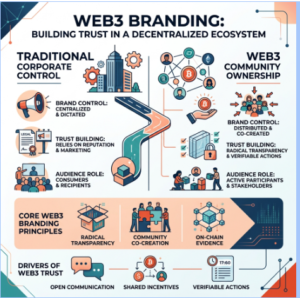
Feature Traditional Corporate Control Web3 Community Ownership Brand Control Centralized, top-down, dictated by marketing teams Distributed, co-created by community, influenced by token holders Trust Building Relies on reputation, advertising, legal frameworks Built on transparency, on-chain proof, verifiable actions Audience Role Consumers, recipients of messaging Active participants, contributors, stakeholders Identity Static, consistent across channels, owned by corporation Dynamic, evolving, portable, often community-governed Growth Model Customer acquisition, market share Ecosystem growth, network effects, incentivized participation Why Brand Identity and Web3 Integration Requires Radical Transparency.
In Web3, transparency isn’t just a buzzword; it’s a foundational principle. Smart contract audits, public ledgers, and an open-source ethos allow anyone to verify transactions and project activity. This level of accountability is unprecedented and forms the bedrock of trust. Brands that embrace this by making their operations, tokenomics, and governance models transparent gain significant credibility. This is particularly vital for projects aiming to be social changemakers, such as those targeting the 31% of adults globally who were unbanked in 2021. For these initiatives, a transparent blockchain explorer interface that clearly shows how funds are managed and distributed can be a powerful tool for building confidence and driving adoption among underserved populations.
Moving Beyond Hype to Real-World Utility

The Web3 space has seen its share of hype cycles, from the NFT boom that saw a 3000% surge to $20 billion in 2021 (only to drop 50% the following year) to the rapid rise and fall of various DeFi projects. Sustainable Web3 brands understand that long-term value comes from real-world utility and solving tangible problems. Marketing efforts must shift from abstract technological promises to practical applications that resonate with a broader audience, including Web2 consumers. This B2C penetration is critical for scalability. Examples include mobile solutions that provide savings and investment access in underserved regions, or platforms that enable rapid international fund transfers via stablecoins. Brands that position themselves as solutions to real-world challenges, rather than just technological novelties, build lasting trust and loyalty.
Visual Systems and the Multisensory Future of Identity
Web3 branding demands a visual identity that is not only aesthetically pleasing but also highly adaptive and functional across diverse digital environments. Static logos are giving way to dynamic, evolving assets. Motion design plays a crucial role in bringing brand narratives to life, while considerations like dark mode optimization and generative visuals ensure adaptability. From metaverse avatars to 3D-ready geometry, Web3 visual systems must be designed for scalability across wallets, apps, and immersive virtual worlds. This is where specialized expertise in Web3 brand identity becomes invaluable, ensuring that visual assets are future-proofed and resonate with a digitally fluent audience.
Designing for the Metaverse and Multisensory Experiences
The metaverse is rapidly becoming a significant frontier for brand engagement. This necessitates a shift towards AR/VR integration, 3D modeling, and truly multisensory branding experiences. Brands are exploring how to engage all five senses within virtual environments, creating immersive storytelling that goes beyond traditional screens. Nike’s Nikeland metaverse platform, with its 7 million users, and Adidas’s successful Into the Metaverse NFT collection, which sold for over $20 million, demonstrate the immense potential of this space. Brands are creating digital-first aesthetics that feel native to these new realms, leveraging dynamic typography and 3D logos that can seamlessly transition between 2D interfaces and volumetric virtual spaces.
Key Elements of a Web3 Visual Framework

A strong Web3 visual framework goes beyond a simple logo. It encompasses a comprehensive suite of elements designed for flexibility and impact.
Essential Visual Assets for Web3 Brands:
- Iconic Symbols & Wordmarks: Simple, scalable designs that are recognizable even in small formats like wallet icons.
- Dynamic Color Palettes: Vibrant, often unconventional palettes that stand out and can adapt between light and dark modes.
- Bold Typography: Typefaces that are readable across various devices and resolutions, often with a futuristic or tech-forward feel.
- Motion Graphics & Animations: Animated logos and UI elements that add depth and convey brand personality.
- 3D Assets & Metaverse Ready Designs: Models and textures optimized for virtual environments, including avatars and virtual spaces.
- Adaptive Layouts: Design systems that automatically adjust to different screen sizes and digital contexts.
- Responsive Elements: Interactive components that react to user input, enhancing engagement.
- Gen Z Aesthetics: Often incorporating elements like neon gradients, minimalist designs, and a rebellious edge to appeal to a younger, crypto-native demographic.
Strategic Evolution: From Visionary Hype to Institutional Trust
Every Web3 project begins with a vision, often fueled by aspirational symbolism and the promise of a decentralized future. However, as projects mature, the market demands tangible proof. The journey from early-stage ‘vision’ to mature ‘trust-building’ involves a strategic evolution of brand identity. It’s a pivot from abstract concepts to concrete evidence, from possibility to proof. This evolution is not merely a design refresh; it’s a narrative pivot that reflects the project’s growth and increasing credibility. For projects seeking institutional adoption or strategic partnerships, a brand that still looks like a nascent startup can be a liability. A professional Web3 dashboard that showcases real-time data and partnerships speaks volumes more than a purely conceptual website. Leveraging AI cheat codes for Web3 identity can help projects rapidly iterate and refine their brand messaging to align with their evolving maturity.
Creating a Lean Framework for Early-Stage Startups
For early-stage Web3 startups, a lean branding framework is crucial. The goal is to establish credibility quickly without overinvesting in elaborate systems that might need to change. This involves defining a minimal brand system that includes a simple, scalable logo, a core color palette, and clear typography. Crucially, early brands need to define their ecosystem positioning: are they infrastructure, a developer platform, a protocol, or a marketplace? This clarity helps simplify complexity for potential users and investors. A credibility-first website with a clear information architecture and professional design is paramount for making a strong first impression. Furthermore, developing repeatable launch assets—templates for landing pages, announcements, and social visuals—ensures consistency as the project scales, optimizing limited resource allocation.
The Journey from Abstraction to Evidence
The brand journey in Web3 is a continuous transition from abstraction to evidence. Early-stage branding often employs aspirational symbolism, illustrations, and emojis to rally initial believers. As a project gains traction, its brand must evolve to reflect this. This means moving towards more photorealistic environments in virtual spaces, incorporating human-centric photography that showcases the community and team, and utilizing data visualizations to illustrate growth and impact. Social proof, case studies of real-world use, and the amplification of major partnerships become central to the brand narrative. This shift from high-level manifestos to benefit-driven product messaging, backed by concrete data, is essential for building trust with a broader audience, including institutional prospects and regulators. It’s about demonstrating, not just dreaming.
Measuring Impact and Avoiding Strategic Pitfalls
Measuring the success of Web3 branding requires new metrics that go beyond traditional marketing KPIs. In a decentralized environment, community engagement, on-chain data, and sentiment analysis provide a holistic view of brand health. An effective Web3 analytics interface can track crucial indicators like token holder retention, share of voice across social platforms, and the volume of creator contributions, providing actionable insights for continuous brand evolution.
Common Branding Mistakes in the Decentralized Space
Despite the unique opportunities, Web3 startups often stumble with branding. Some common pitfalls include:
- Overpromising and Underdelivering: Claiming full decentralization while retaining centralized control erodes trust quickly.
- Rigid Identity Systems: Creating a static brand that cannot adapt to new technologies (e.g., metaverse, NFTs) or community input.
- Contradictory Tokenomics: Designing token incentives that misalign with stated brand values or encourage short-term speculation over long-term engagement.
- Ignoring Developer Audiences: For technical projects, failing to build a brand that resonates with developers (e.g., poor documentation, inconsistent UI).
- Hype-Driven Marketing: Relying solely on buzzwords and trends (like the NFT peak and subsequent drop) without focusing on utility and sustainability.
- Design-by-Committee Risks: Excessive community input without clear guardrails can lead to incoherent or diluted brand assets.
- Lack of Clarity: Overcomplicating messaging or visuals makes it difficult for users to understand the project’s core purpose.
Avoiding these mistakes requires a strategic, adaptive, and community-centric approach to branding.
Future Trends in Brand Identity and Web3
As Web3 continues to mature, several trends are poised to shape the future of brand identity:
- AI-Driven Personalization: Leveraging AI to create highly personalized brand experiences and dynamic visual identities that adapt to individual user preferences.
- Cross-Chain Identity: Brands will need to manage and present their identity seamlessly across multiple blockchain networks, ensuring consistency and interoperability.
- Token-Gated Experiences: The use of NFTs and other tokens to grant exclusive access to brand content, communities, and events will become more sophisticated.
- Multisensory Metaverse Stores: Brands will deepen their presence in virtual worlds, offering immersive shopping and interaction experiences that engage all senses.
- Decentralized Social Media Reputation: As social platforms decentralize, a user’s on-chain reputation and contributions will increasingly influence their interactions with brands.
These trends highlight the need for brands to remain agile, innovative, and deeply connected to the evolving technological and cultural landscape of Web3.
Frequently Asked Questions about Web3 Branding
How does Web3 branding differ from traditional corporate branding?
Web3 branding fundamentally shifts from corporate control to community co-creation. While traditional branding emphasizes consistent, top-down messaging and static visual guidelines, Web3 branding embraces dynamic identities, radical transparency, and on-chain verifiable trust. It integrates tokenomics and incentivized participation, turning users into active stakeholders who influence the brand’s evolution. Unlike Web2, where brands own their narrative, Web3 brands facilitate a narrative shaped by their decentralized communities.
When is the ideal time for a Web3 startup to invest in professional identity design?
The ideal time is early—ideally before launching a website, developer program, or seeking significant partnerships. In a low-trust environment, a credible and professional brand identity acts as an immediate signal of legitimacy. A minimal, well-designed brand system can significantly improve first impressions with investors, developers, and early adopters, making it easier to attract talent and secure funding. Waiting until later stages can result in a fragmented identity that is costly to rectify and undermines initial trust.
How can on-chain data be used to measure brand sentiment and loyalty?
On-chain data offers unprecedented transparency for measuring brand sentiment and loyalty. Metrics can include token holder retention rates, the number of unique contributors to a DAO, the volume and frequency of token transfers (indicating active usage vs. speculation), and the participation rates in governance votes. By analyzing these on-chain activities, combined with off-chain sentiment analysis from social media and community forums, projects can gain a comprehensive understanding of how deeply engaged their community is, whether they are aligned with the brand’s values, and the overall health of their brand’s ecosystem.
Conclusion
As we navigate April 2026, the Web3 landscape continues to expand its influence, offering a future where brands are not just commodities but cultural infrastructure built on shared values and collective ownership. For modern creators, understanding and leveraging the unique dynamics of Web3 branding is no longer optional; it is essential for future-proofing their ventures. By embracing decentralization, fostering radical transparency, and committing to real-world utility, brands can cultivate profound trust and build vibrant, participatory communities.
The journey from a visionary concept to a trusted institution in Web3 requires strategic adaptability, a deep commitment to community-centric growth, and a recognition of the powerful intersection of technology and human emotion. Those who master these principles will not only survive but thrive, shaping the decentralized future of the internet.